


NO HOSE. NO OUTLET.
Cleans where nothing else will start
Cordless Portable Pressure Washer
Cordless Portable Pressure Washer
- Draws its own water from a bucket, barrel, tank or lake
- Battery on board — the outlet is never asked
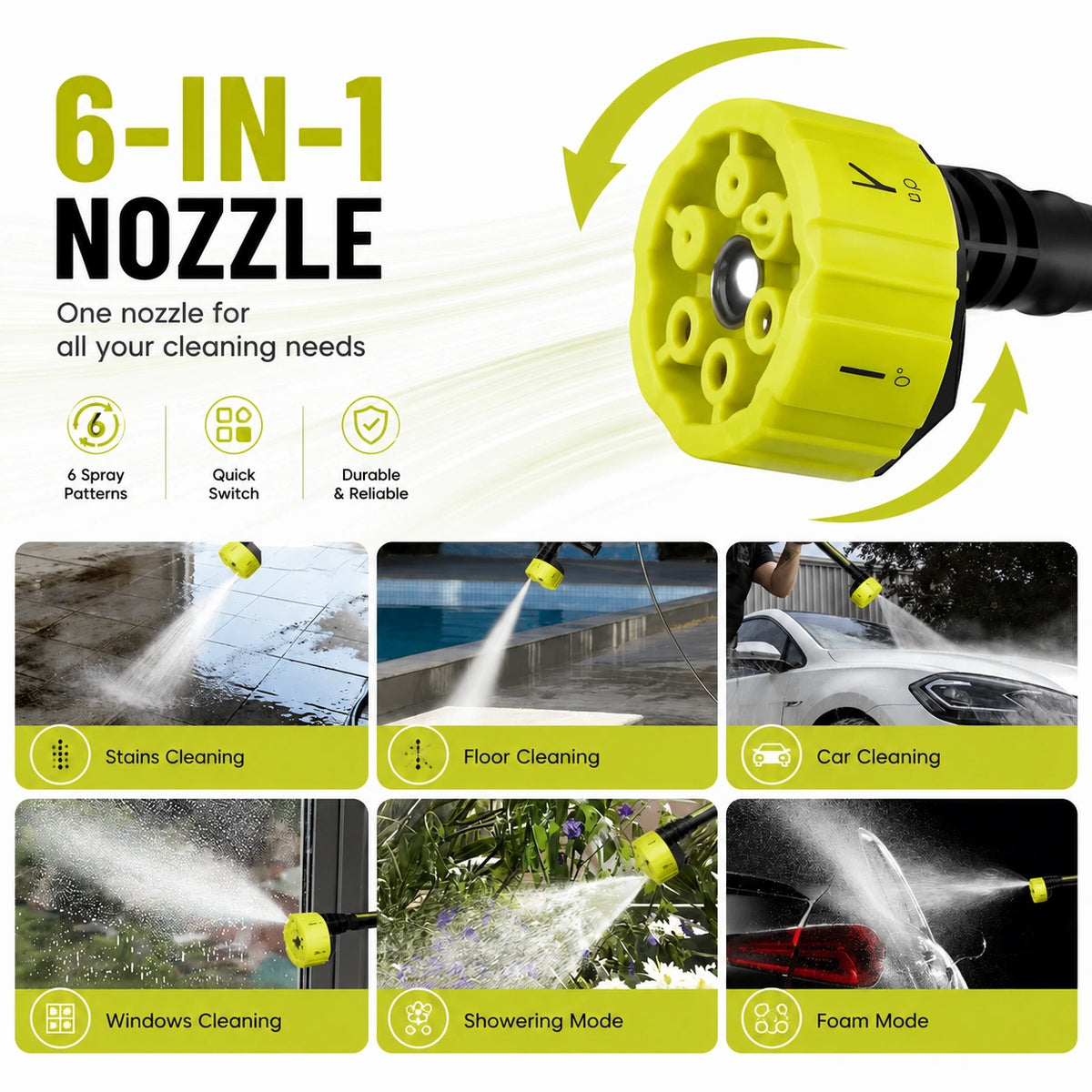
- Twist the nozzle: wide paint-safe fan → focused jet
- One arm to carry out, one thin hose to coil back
- 90 days to try it — we pay the return shipping
HURRY! Deal ends at 11:59 PM
Couldn't load pickup availability
Get it between - and -.
Description
Description
A pressure washer small enough to hold in one hand, that runs off the battery inside it and drinks its water out of whatever you've got — a bucket, a jerry can, a barrel, a rain tank, a lake.
Pull the trigger and the pump inside lifts water up the intake hose, squeezes it, and sends it out as a fast jet. A gas or corded washer physically cannot do that: those need water that is already moving, arriving under mains pressure from a spigot. Hand one a bucket of still water and it does nothing at all. This one starts there.
Twist the nozzle to set the shape — wide flat fan at one end of the range, narrow focused jet at the other. Same water; the shape decides how hard it lands.
How to use
How to use
1. Drop the intake hose into your water — bucket, drum, barrel, tank, jug or lake.
2. Twist the nozzle to the shape you want: wide fan for paint and delicate surfaces, focused jet for caked-on grime.
3. Squeeze and clean. When you're done, coil one thin hose back into the case.
Best on the jobs a handheld is right for: wheels and arches, grill grates, patio furniture, fence panels, bikes, muddy boots, garden tools, window frames, kayaks and dog paws.
Shipping & Returns
Shipping & Returns
Free shipping on every order, processed in 1–2 business days and delivered in 5–12 with tracking.
Then 90 days to use it on your worst job. If it isn't for you, we pay the return shipping — no restocking fee, no handling fee, no “per-item” charge, and nothing you have to insure yourself.
NO RISK 100% Money Back Guarantee
We get it - you've been disappointed before. So here's our promise: Try Cordless Portable Pressure Washer for 90 days and if your feet don't feel the difference, we'll refund every penny you paid — free return shipping, prepaid label, no restocking fee, and we'll never offer you a partial refund to keep them. No hoops. No hassle.

Cordless Portable Pressure Washer


As Seen On


It was never the dirt. It was the chore before the chore.
Twenty minutes of setup before one drop of water. Twenty more of coiling owed afterwards. So you look at the truck, and the truck stays dirty another week.
You didn't get lazy and you didn't buy the wrong size. Every pressure washer you've owned had to be dragged to a tap and a plug that were never going to move.

THE PART NOBODY TELLS YOU
A pressure washer doesn't make pressure. It borrows it.
It's an amplifier bolted between two supply lines it doesn't own, anchored at a spot it can't leave. So the number on the box was only ever a ceiling. What actually came out of the nozzle was decided by your building, your well, your engine, or a coin box — never by you.
That's why the plug didn't fit, why three spigots starved it, why the engine picked the day, and why you paid in quarters to clean your own car. You were never short of pressure. You were short of control over where it got made.
So this one stops asking. The pump leaves the wall, travels to the mess, and recruits all three inputs on arrival. That's Self-Sourced Pressure™.
The pump travels to the mess instead of the mess coming to the tap
It lifts water that isn't moving — a bucket counts as a water source
You set the force by hand, mid-job, instead of a factory setting it
Self-Sourced Pressure™ — all three inputs, carried
Water, power and force — the three things every other washer has to borrow from your address. This one recruits all three on arrival, at the mess.

The Carried Pump
Inside the handle. Lifts water out of a source with no pressure of its own.
The Carried Charge
Rechargeable battery on board — the outlet is never asked for anything.
The Dialed Force
Twist to set the spray shape: wide paint-safe fan through to focused jet.
The supply line
One thin intake hose. Drop the end in a bucket, drum, barrel, tank or lake.
PART ONE
The Carried Pump
The pump is in your hand, and it works by lifting. Drop the intake hose into still water and it draws — which is exactly the thing a gas or corded machine cannot do, because those need water already arriving under pressure. The water line stops being a fifty-foot negotiation with your plumbing and becomes a container at your boot.

PART TWO
The Carried Charge
The battery is on board, so the electrical feed is never requested. The plug that “won't fit in the outdoor outlet” isn't a smaller problem — it stops being a problem that exists. Nothing to route through a window, nothing to coil, nothing for a landlord to have an opinion about.

PART THREE
The Dialed Force
Force at the surface is a shape you set at the nozzle, one-handed, mid-job — wide flat fan for paintwork, narrowed to a focused jet for baked-on grime. Power you dial, not power that happens to you. It's the one thing a gas engine can never offer, because it knows exactly one setting: everything.
Why the others couldn't start here
Not a power contest — a contest about which inputs the machine has to borrow from your building before it will do anything at all.
| Selorna | Gas washer | Corded electric | Hose-end nozzle | |
|---|---|---|---|---|
| Works with no garden hose | ||||
| Works with no power outlet | ||||
| Draws from a bucket, barrel or lake | ||||
| Nothing to start, prime or winterise | ||||
| Force you set by hand, mid-job | ||||
| Carried in one arm | ||||
| No fuel, oil or carburettor service | ||||
| Usable on an apartment patio | ||||
| 90 days — and we pay the return shipping |

WHAT IT IS — AND ISN'T
The honest version
This category lies about numbers, gets caught, and the buyer ends up feeling like the mark. So here is the part nobody else prints.
What people post after the first weekend
Mostly from people who already owned a washer they couldn't use where they live.
-

3d
No hose bib anywhere on my property. I'd genuinely given up and was paying for the drive-through. Filled a drum, dropped the hose in, did the whole truck in the driveway.

1.3k
88 Comments
LikeCommentShareNo spigot, no plug. That's the entire reason I bought it.
38m Like Reply
-

5d
Apartment patio, third floor. My old corded one was useless here because the outdoor outlet wouldn't take the plug. Did the balcony, the chairs and the grill in one go.

1.0k
64 Comments
LikeCommentShareDoes the HOA give you trouble?
2h Like ReplyNothing to plug in and no hose running anywhere, so there's nothing to complain about.
38m Like Reply
-

1w
The gas one hadn't started in two years and the repair quote was over half a new machine. Sold it. Bikes, boots and the grill grates now take minutes instead of a whole morning.

1.5k
97 Comments
LikeCommentShareIs it strong enough for actual grime or is it a toy?
2h Like ReplyIt's a handheld, not a driveway stripper. For the stuff I actually clean weekly it's plenty.
38m Like Reply


From people who'd stopped bothering
Rated 4.9 / 5.0 across 1,237+ reviews.
-

No spigot, no problem
No hose hookup anywhere on my property, so this was a lifesaver. Feels solid in the hand while working.
-

The wheels finally came clean
Finally got the grime off my wheels in the driveway. The way it lifts the dirt is genuinely satisfying.
-

Less like a chore
Made washing the truck feel way less like a chore. Love that I can just grab it and go — no setup, no coiling afterwards.
-

Years of dust, a few minutes
Pretty impressed how it handles years of dust. My patio looks new again after a few minutes.
-

The kids helped
My boys actually had fun helping me do the car. Easy to store in the garage too — it's one small case.
-
For quick touch-ups
Perfect for the jobs where I don't want to drag out the heavy equipment. Moves around really easily.
-

Took it camping
Boots, the dog and the kayak, all at the campsite, out of a jug. That's the whole reason I bought it.


Where it actually gets used


FAQ
The questions a burned buyer actually asks

Is it actually powerful enough, or is it a “squirt gun”?
Is it actually powerful enough, or is it a “squirt gun”?
Straight answer: it is a handheld, and it is not a 2,000-PSI machine. It won't strip a driveway or lift an old oil stain out of concrete — if that's your job, keep the big one. What it does is put usable pressure exactly where you're standing, on the jobs a handheld is right for: wheels, grill grates, patio furniture, fence panels, bikes, boots, garden tools and dog paws. Pick the model that matches how hard you need it to land, and set the spray shape at the nozzle from there.
Where does the water come from if I don't have a hose?
Where does the water come from if I don't have a hose?
From whatever container you put the intake hose into — a bucket, a jerry can, a drum, a barrel, a rain tank, a jug from the kitchen, or a lake. The pump lifts water that isn't moving, which is precisely the thing a gas or corded washer cannot do. It makes its own supply line, not its own supply, so for bigger jobs just use a bigger container.
Do I need an outdoor power outlet?
Do I need an outdoor power outlet?
No. The battery is on board, so there is nothing to plug in and nothing to route through a window. That's usually the whole reason people who live in apartments, rentals or older houses end up here.
Will it damage paint, or is it too gentle to be useful?
Will it damage paint, or is it too gentle to be useful?
Both are settings, and you choose. Twist the nozzle to a wide flat fan for paintwork and delicate surfaces, or narrow it to a focused jet for baked-on grime. Same water either way — the shape decides how hard it lands, and you can change it mid-job with the same hand.
What happens if it isn't right for me?
What happens if it isn't right for me?
You get 90 days to use it on your worst job, and we pay the return shipping. No restocking fee, no handling fee, no per-item charge, nothing to insure yourself, and no membership to cancel. Free shipping on the way out, too.

Tony M.
Wait, it pulls out of a drum? No spigot at all?