


SIZED FROM A CHILD
Not an adult pillow shrunk down
Kids Ergonomic Posture Pillow
Kids Ergonomic Posture Pillow
- Height and ridge set from a child's own shoulder gap
- Low enough it can't fold the neck forward
- Ridged enough the head can't drop back and the mouth fall open
- Removable, washable, breathable cover
- 90 nights to judge it — 3× the category standard
HURRY! Deal ends at 11:59 PM
Couldn't load pickup availability
Get it between - and -.
Description
Description
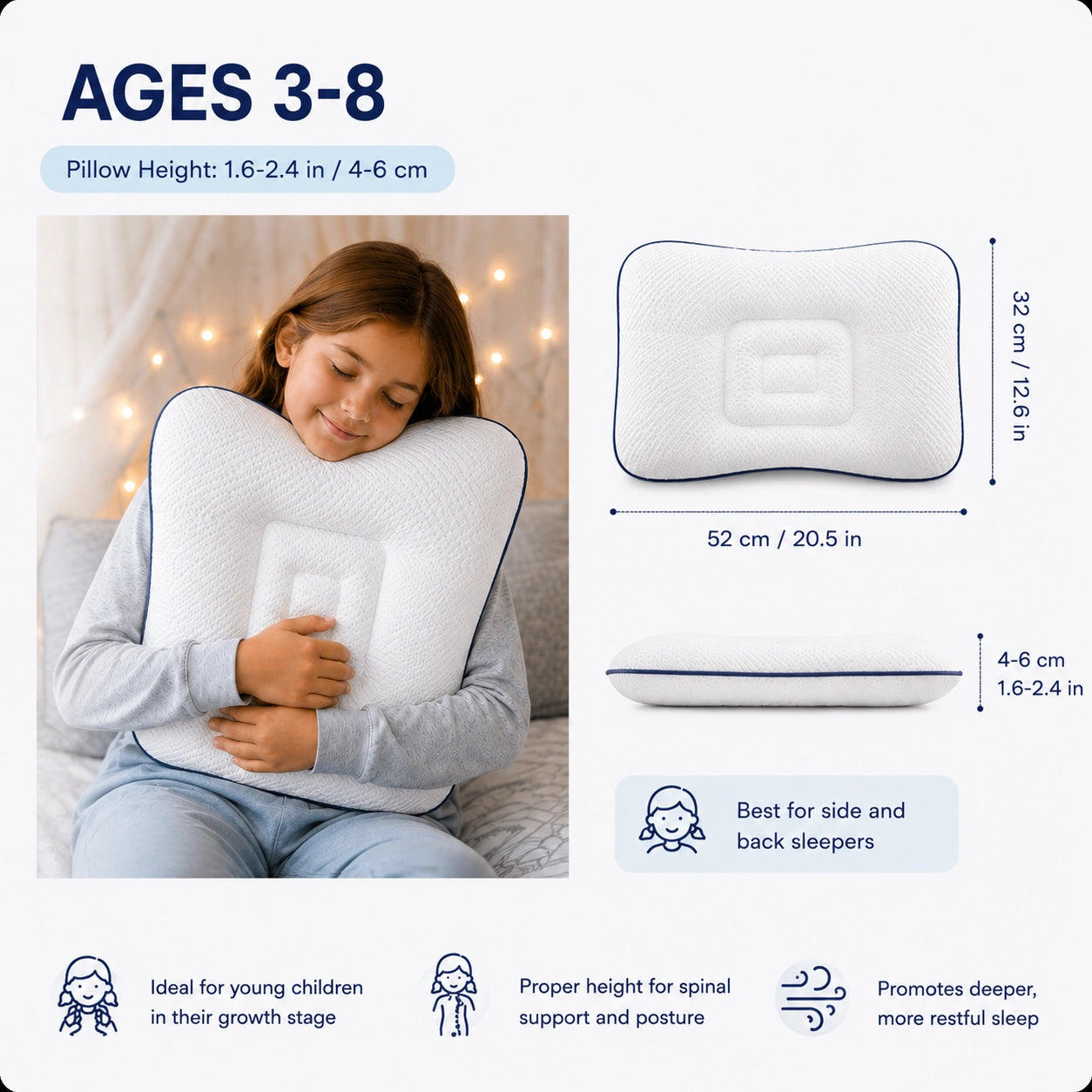
A pillow built for a child, not an adult pillow made smaller. Held next to the one on your own bed the difference is obvious: it sits much lower, and side-on it has a shape — a low, shallow field where the back of the head goes, and a gently raised ridge that sits under the neck.
That combination is the point. Low enough that it cannot fold a small neck forward; ridged enough that the head cannot sink back and tip the chin up — the position that lets the mouth fall open for ten hours a night.
The cover comes off and goes in the wash: soft, breathable, hypoallergenic, skin-friendly. Choose the age that matches your child.
How to use
How to use
1. Lay it flat on the bed — this is a sleep pillow, it is never worn around the neck.
2. Turn the raised ridge toward their shoulders.
3. Head on the low field, neck resting over the ridge. Back or side sleeping both work.
That's the whole thing. Nothing to inflate, adjust, strap or learn.
Tonight, before you buy anything: slide a hand into the gap under your sleeping child's neck. If your hand won't fit, the pillow is too tall and the neck is folded. If the whole hand fits with room to spare, it's too flat and the head has dropped back. Neither one is neutral.
Shipping & Returns
Shipping & Returns
Free shipping on every order, processed in 1–2 business days and delivered in 5–12 with tracking.
Then 90 nights to judge it — three times the trial mellow, Lussi and KeaBabies give you, and we don't footnote ours. If your child's nights haven't changed, send it back for a full refund.
NO RISK 90-Night Money Back Guarantee
We get it — you’ve bought pillows before that ended up on the pile. So here’s our promise: sleep on Kids Ergonomic Posture Pillow for 90 nights, and if your mornings haven’t changed, we’ll refund every penny — free return shipping, prepaid label, no restocking fee, no handling fee, and no “destroy it and send photos.” The trial is 90 nights because 30 isn’t long enough to catch what actually goes wrong with pillows. No hoops. No hassle.

Kids Ergonomic Posture Pillow


As Seen On


The open mouth isn't cute. It's a signal.
Go and look at them tonight. If their head is tipped back and their mouth has fallen open, they aren't sleeping deeply — they're working to breathe.
And the thing holding their head at that angle, for ten hours a night, every night, is the pillow you were handed no instructions for.

NOBODY EVER MEASURED THE CHILD
It isn't teething, and it isn't a phase.
A pillow has exactly one job: fill the gap your child's own shoulder makes between their head and the mattress. On a small child that gap is a fraction of an adult's — but every pillow they've ever slept on had its height, and the position of its neck ridge, set from an adult's body and then shrunk.
Overfill that gap and the neck folds forward. Leave it empty and the head drops back, the chin lifts, and the mouth falls open. Both bend the same neck, in opposite directions, for ten hours a night.
That's the mismatch ShoulderLine™ exists to close — the pillow's height and its ridge position both set from a child's own head-to-shoulder gap.
The low field — nothing left over for the neck to fold across
The gentle ridge — the gap stays closed instead of collapsing
Too shallow to form the deep, soft cavity that scares you

DO THIS TONIGHT — IT'S FREE
The hand test
Slide a hand into the space under your sleeping child's neck.
Your hand won't fit? The pillow is too tall — their neck is folded forward all night.
The whole hand fits with room to spare? It's too flat — their head has dropped back and their chin is lifting.
Neither one is neutral. You don't need to buy anything to run this, and it will tell you more in ten seconds than another month of bedtime routines.
Two numbers, one relationship
Every other kids' pillow adjusts exactly one thing — total thickness — so each has to choose which failure it commits. This one sets the field and the ridge against each other.

The low field
Where the back of the head rests — close to the mattress, so there's no excess height to fold a small neck across.
The gentle ridge
Rises into the one place a child actually has a gap: the hollow behind the neck.
Shallow by design
Too shallow to form the deep, soft, collapsing cavity that every horror story is actually about.
The washable cover
Comes off and goes in the machine — soft, breathable, hypoallergenic, skin-friendly.

WHAT YOU SEE
A mouth that stays open
Head tipped back, lips parted, a damp patch on the sheet. Parents are told it's teething, a cold, or just how they sleep. It is a position — and a position is set by whatever is under the head.

WHAT DENTISTS CALL IT
Long face syndrome
Airway-focused dentists have a name for the pattern that follows habitual mouth breathing: the tongue drops from the roof of the mouth, the jaw sits back, the palate narrows, and the face grows downward instead of forward. It is the single most-cited reason they ask about a child's sleep at all.

WHY IT'S URGENT NOW
The window narrows around age nine
The palate is two halves joined by a suture that fuses in the years around nine. Before that, the shape is still being set every night. After it, changing it stops being a pillow conversation and starts being an orthodontic one — expanders, years of braces, and in the hardest cases jaw surgery.
Why the last one didn't work
Every option on the shelf adjusts one number. The mismatch that matters is a relationship between two.
| Selorna | Adult hand-me-down | $30 “kids memory foam” | Flat toddler pillow | |
|---|---|---|---|---|
| Height set from a child's shoulder gap | ||||
| Ridge placed for a child's neck, not an adult's | ||||
| Low enough it can't fold the neck forward | ||||
| Supports the neck instead of letting the head drop | ||||
| Too shallow to form a deep soft cavity | ||||
| Removable, washable cover | ||||
| Sized options for your child's age | ||||
| 90-night trial, free shipping |
WHY AIRWAY DENTISTS ASK ABOUT SLEEP
“I can see how a child sleeps in the shape of their face.”
— Dr. Maren Cole, DDS, pediatric airway focus
Three things she checks before anything else, and every one of them is decided by the position a child's head is held in all night.
What parents post after the first two weeks
Mostly from parents who'd already fixed the schedule, the blackout and the sound machine.
-

4d
I did the hand test on a whim and my entire hand fit under her neck. She'd been on my old guest pillow for a year. Two weeks on this one and the snoring is just… gone.

1.6k
112 Comments
LikeCommentShareSlide your hand under their neck while they sleep. If it fits easily the pillow's too flat.
45m Like Reply
-

6d
Our dentist was the one who asked how he slept. Mouth open every night. She explained the whole face-growth thing and I went home and looked at his pillow properly for the first time.

1.2k
84 Comments
LikeCommentShareDid she recommend a specific one?
2h Like ReplyShe said low, with actual neck support. Took me ages to find one that was both.
45m Like Reply
-

1w
Bought the 8-16 for my eleven-year-old thinking we'd missed the window. He stopped waking up with a headache within about ten days. Wish I'd known when he was three.

1.4k
96 Comments
LikeCommentShareIs it worth it for an older kid?
2h Like ReplyFor us yes. He sleeps quieter and mornings stopped being a fight.
45m Like Reply


From parents who'd tried everything else
Rated 4.9 / 5.0 across 1,232+ reviews.
-

The snoring stopped
My daughter used to wake up so stiff, and she snored every night. Since switching she actually sleeps through and the room is quiet.
-

Her mouth stays closed now
I check the monitor out of habit. Two weeks in, her lips are together and she's breathing through her nose. I didn't know that was a thing to look for.
-

No more “my neck hurts”
Three mornings a week he'd wake up rubbing his neck and telling me his head hurt. That has completely stopped.
-

Finally one that isn't a pancake
We're three kids' pillows deep. The others were either flat as paper or so thick her chin was on her chest. This is the first one she's kept.
-

Bought it for the older one too
Started with my youngest, saw the difference, ordered the 8-16 for my son. Both sleeping quieter.
-

The cover washes properly
Kids being kids, it's already been through the machine twice. Comes off easily, goes back on easily, no complaints.
-

The hand test sold me
I tried it before ordering, out of scepticism. My whole hand fit under her neck with room to spare. That was all the proof I needed.


CHOOSING THE SIZE
Pick the one that matches your child
Three options — 1–3, 3–8 and 8–16 — because a four-year-old's shoulders and a twelve-year-old's are not the same measurement, and the whole point is matching the gap.
Not sure which side of a boundary your child falls on? Order either and use the 90 nights — if it's the wrong one, send it back and we'll sort it.
Under one year old: please don't use a pillow at all. Safe sleep guidance is a flat, clear sleep surface, and no pillow we could sell you changes that.
FAQ
The questions parents actually ask

My child is a bad sleeper — how do I know it's the pillow and not something else?
My child is a bad sleeper — how do I know it's the pillow and not something else?
You don't, until you check — which is why the hand test exists and costs nothing. Slide a hand under their neck tonight: if it won't fit, the pillow is folding their neck forward; if the whole hand fits with room to spare, their head has dropped back. Night waking has many causes and we'd be lying if we said a pillow fixed all of them. What a pillow owns completely is the angle their neck is held at for ten hours — and that's the one cause almost nobody checks.
Isn't a pillow unsafe for a small child?
Isn't a pillow unsafe for a small child?
The fear is pointed at the right danger with the wrong variable. What makes a pillow dangerous is adult depth and a soft, collapsing mass a small face can sink into. A pillow shallow enough to close only a child's gap is physically too shallow to form that cavity. That said: under one year old, no pillow at all — a flat, clear sleep surface, every time.
What if my child just refuses it, like the last three?
What if my child just refuses it, like the last three?
Entirely possible — kids are the only judge that counts, and most of the category's one-star reviews are a parent reporting exactly that. It's why the trial is 90 nights rather than 30. Mellow, Lussi and KeaBabies all give you thirty days while telling you the change takes weeks. If yours won't sleep on it, send it back.
Can I wash it?
Can I wash it?
The cover is removable, machine washable, breathable and hypoallergenic — which matters on an object that takes drool, nosebleeds and worse. We'll be straight with you: the claim is the cover, not the core. Anyone telling you a foam core is fully machine washable is setting you up for a 3am discovery.
My child is nine or older — is it too late?
My child is nine or older — is it too late?
The palate suture fusing around nine is why the early years matter most, but it isn't a door slamming. Older children still spend thousands of hours a year in whatever position their pillow sets, and the 8–16 size exists for exactly that. What we won't tell you is that a pillow straightens a posture that's already set — it stops the night from making it worse. If there's loud snoring, gasping or long pauses in breathing, please see an ENT or an airway-focused dentist. And skip the mouth-taping trend — it is not appropriate for children.

Amy L.
Wait what hand test?