


10 Reasons Parents Are Swapping Their Child's Pillow Before Age 9 — The Face They'll Wear At 18 Is Being Shaped Tonight
The mouth hanging open. The drool patch. The little snore everyone calls cute. Most parents are told it's nothing — and pediatric airway dentists have spent twenty years watching what it turns into: narrow palates, receded chins, crowded teeth, and orthodontic bills that start at $5,000. The window to change it doesn't stay open forever. Here's what airway-aware parents are doing about it — starting with the thing under their child's head tonight.
By the Selorna Family Sleep Desk · Reviewed by Dr. Maren Cole, DDS — pediatric airway focus · Last updated August 2026
The Open Mouth Isn't Cute. It's A Signal.
You've seen the picture: mouth open, a damp patch on the pillowcase, the soft little snore relatives smile about.
Airway specialists read that picture differently. A child whose mouth falls open every night isn't breathing the way a growing face is designed to — through the nose, lips resting closed, tongue up on the palate where it belongs.
Every open-mouth night quietly casts a vote on how that face grows. The good news: at this age it's still a vote — not a verdict.

Airway Dentists Have A Name For It: Long Face Syndrome
When the mouth hangs open all night, the mechanics shift: the tongue drops off the roof of the mouth, the jaw slides back, and the palate narrows into a high, cramped arch.
Over thousands of nights the face starts growing down instead of forward. Specialists call the result long face syndrome — longer lower face, weaker chin, flatter cheekbones, dark circles, teeth with nowhere to fit. Airway researchers have documented it for two decades; a bestselling book made adults care about their own breathing. Almost nobody told parents.
Most pediatricians aren't trained to screen for it. Which means the person most likely to catch it early is you.

It Starts With The Pillow Under Their Head
Put a child on an adult-height hand-me-down pillow and watch from the side: the head sits at an angle the jaw can't hold — so it falls open, and the mouth does the breathing all night.
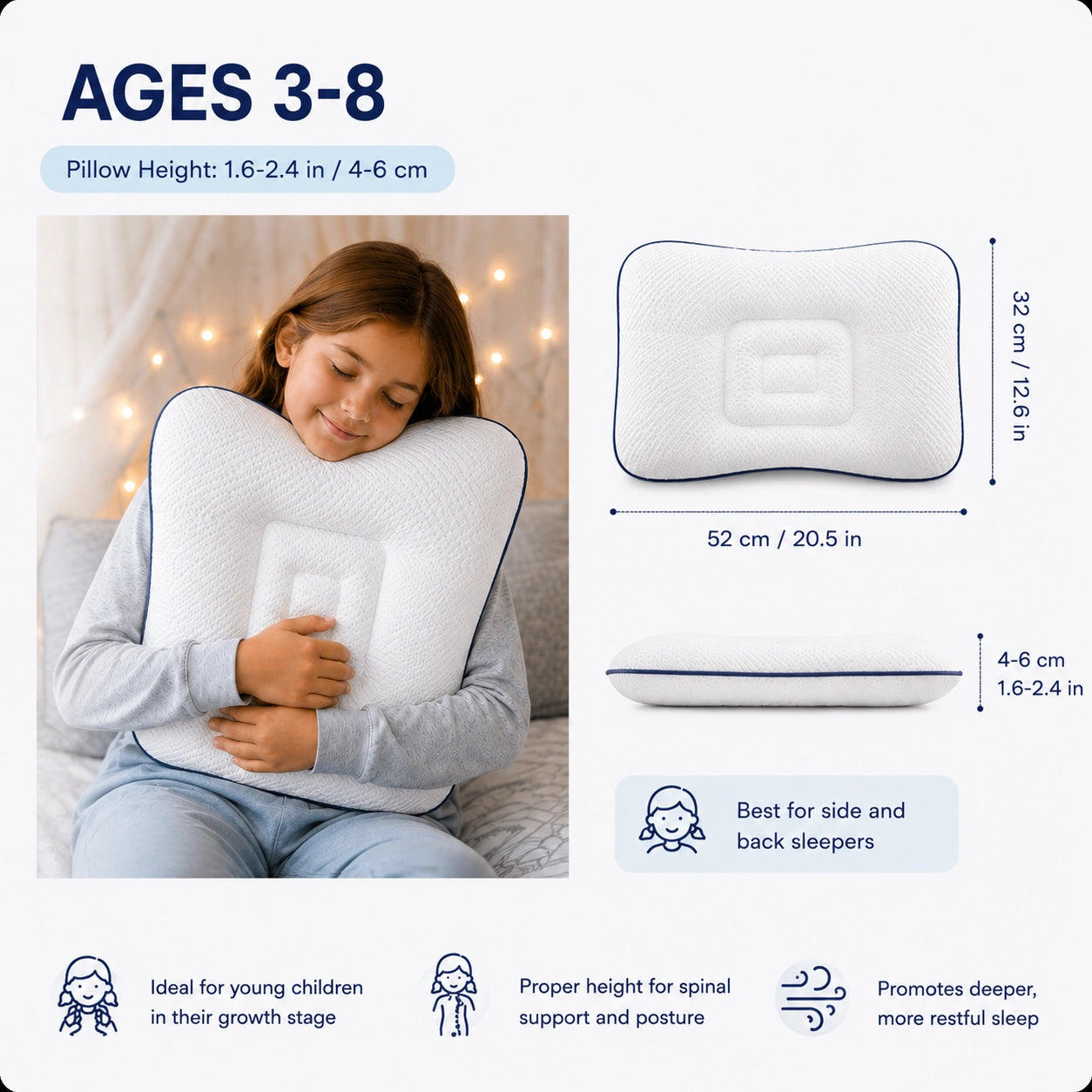
This pillow attacks the position, not the symptom. The height is set from a child's own head-to-shoulder gap so the head lands level; the gentle ridge fills the hollow behind the neck so the head can't tip back — and the lips can simply rest closed. That's the ShoulderLine™ standard.
It doesn't teach your child to nasal-breathe. It removes the position that was preventing it.

The Age-9 Deadline Is Real
Between roughly 3 and 9, the upper palate is still soft enough to widen as the child grows. Around 9, its growth seam knits — and the shape it's in is largely the shape it keeps.
That's why what's correctable at 5 becomes a $5,000—$8,000 phase-one orthodontics conversation at 14, and why jaw surgery enters the room at 18. Ask any orthodontics parent what they wish they'd known ten years earlier.
You don't need to panic. You need to change one thing tonight, and let a few thousand nights of better position do the compounding for you.

What Parents Notice First
Nights 3—7: the breathing gets quieter and the tossing settles. Nights 7—14: lips resting closed, a dry pillowcase, no more desperate water glass first thing in the morning.
Weeks 3—4: the dark circles start to soften, and mornings stop being a hostage negotiation.
Every child's timeline is different — which is exactly why you get 90 nights to judge it, not 14.

Snoring Is Not A Personality Trait
That “cute” snore is the sound of air forcing its way through a narrowed path. Pediatric ENTs treat it as the first flag for disturbed sleep — the pauses, the gasps, the shallow nights that steal the deep sleep growing brains run on.
A level head and a supported neck keep the airway in line for the whole night, and most parents tell us the room goes quiet inside the first week or two.
Silence, it turns out, is what healthy kids' sleep sounds like.


Kids Ergonomic Posture Pillow
Kids Ergonomic Posture Pillow
Kids Ergonomic Posture Pillow
Get it between - and -.


Older Kids Are Not Out Of The Window
The palate seam knits around 9 — but the lower jaw keeps growing into the late teens, and the airway keeps adapting the whole way.
The tween who “can't wake up,” the headaches, the slipping focus everyone blames on screens — very often that's a kid sleeping shallow behind a blocked airway, not a lazy kid.
That's why this pillow runs in sizes up to age 16: the same mechanism, dimensioned for bigger shoulders. Later is harder. Later is not never.

Sized From A Child's Shoulders — Never Shrunk From An Adult Pillow
A 4-year-old and a 14-year-old don't share shoulders — so one “kids” size is a guess, and a scaled-down adult pillow is a worse one.
Three sizes cover the whole run: 1—3, 3—8, and 8—16 — each with its height and neck ridge set from that stage's head-to-shoulder gap.
On the overlap years, size up: the pillow should fit the child they're becoming, not the one they were.

Safe For The Face That's Pressed Against It
Your child spends up to ten hours a night with their cheek on this thing. The materials have to answer for that.
Hypoallergenic shape-holding foam. A soft, breathable knit that lets heat and moisture out instead of trapping them. No harsh chemical smell out of the box.
And because kids are kids: the cover zips off and machine-washes, and the core keeps its shape instead of absorbing the week's accidents.

One Pillow Tonight — Or Thousands Later
Run the honest math: phase-one braces start around $5,000. Airway therapy programs run into the thousands. Surgical fixes later are a different number entirely. This pillow is $104.95 — with 90 risk-free nights.
So watch for the specific changes: lips resting closed. Quiet nights. A dry pillowcase. Easier mornings. If you're not seeing them by night 90, send it back — free both ways, prepaid label, no restocking fee, every penny returned.
It's the cheapest airway insurance a parent can buy. And the only one that works while your child sleeps.

What Customers Are Saying
The drool patch disappeared
My son's pillowcase was soaked every single morning and everyone told me it was normal. Eight nights on this and his lips stay closed, the pillowcase is dry, and the snoring is gone. I didn't realize how loud my worry was until the room went quiet.
Our dentist asked what changed
At the last checkup our pediatric dentist said his bite was tracking better and asked what we'd been doing. The only thing we changed was the pillow. I nearly cried in the chair.
13 years old, and it still worked
My daughter snored like an adult and dragged herself through every morning. Three weeks on the bigger size: quiet nights, the alarm works on the first try, and her headaches have backed way off. I wish we'd known at 5 what we know at 13.
Your Questions, Answered
Most parents notice quieter breathing inside the first week, lips resting closed and a dry pillowcase by week two, and softer dark circles with easier mornings over weeks three to four. Every child's timeline differs — that's why the trial is 90 nights.
Three sizes: 1—3 years, 3—8 years, and 8—16 years — each dimensioned from that stage's head-to-shoulder gap. On overlap years, size up. For children under 2, check with your pediatrician first; for babies under 1, no pillow at all — full stop.
The younger, the faster the turnaround — but the lower jaw keeps growing into the late teens and the airway keeps adapting the whole way. The longer the habit has run, the more visible the change tends to be once the position is fixed. Later is harder; later is not never.
Position. On a wrong-height pillow the head sits at an angle the jaw can't hold, so the mouth falls open and does the breathing. This pillow lands the head level and fills the hollow behind the neck so the head can't tip back — which lets the lips simply rest closed and the nose take over.
A hypoallergenic, shape-holding foam core under a soft, breathable knit cover — skin-friendly, low-profile, and free of the harsh chemical smell cheap foam ships with. The cover zips off and machine-washes; keep the core itself dry.
Almost always within 1—3 nights. To a child it's just a comfortable pillow — there's no device feeling, no “right way” to enforce, no bedtime battle.
Not for children — pediatric dental bodies warn against taping kids' mouths. Fix the position that forces the mouth open instead of sealing it shut, and the lips close on their own.
For positional snoring — the most common kind in kids — most parents report the room going quiet within the first two weeks. Honest note: if your child snores loudly every night with pauses or gasps, see a pediatric ENT as well. A pillow supports an airway; it doesn't treat everything.
Free on every order. Orders process in 1—2 business days and deliver in 5—12, with tracking as soon as it ships.
You get 90 nights from delivery. Watch for the checklist: lips closed, quiet nights, dry pillowcase, easier mornings. Not seeing it? Returns are free both ways with a prepaid label, no restocking fee, and you get back every penny. Email support@selorna.com — a real person answers.