


10 Reasons Homeowners Are Ditching Gas Washers & Garden Hoses For This Cordless Power Washer
The gas washer that won't start when the deck needs doing. The cord that doesn't reach the one outdoor outlet. The four-hour Saturday on your knees with a brush, for a result you'd politely call “mediocre.” If that's your cleaning routine, here's the part nobody tells you: it was never you — it was the tether.
By the Selorna Home Desk · Last updated August 2026
It Skips The Chore Before The Chore
Be honest about what cleaning actually costs you: dragging fifty feet of hose, hunting the adapter, coiling the cord, the pull-start that needs three tries and a prayer. The setup is the real enemy — not the dirt.
This one lifts out of its case, clicks a battery in, and is spraying inside a minute. No hose to the spigot. No cord to the wall. No fuel, no choke, no winterizing.
The job you've been putting off for a season stops being a production. That's why it actually gets done.

It Makes Its Own Pressure — Straight From A Bucket
Here's the secret nobody selling pressure washers says out loud: a gas or corded washer doesn't make pressure — it borrows it from your house. Your spigot, your outlet, your water line. If your house can't feed it, the number on the box means nothing.
This one carries its own pump and lifts water out of still sources — a bucket, a barrel, even a pool — up to 4 meters. The water line stops being a negotiation with your plumbing and becomes a container at your boot.
That's the whole trick: the pressure is finally yours, and it goes wherever the mess is.

No Outlet. No Hose Bib. No Permission Needed.
Apartment parking lot. The back fence the hose has never once reached. The boat ramp. The campsite. The buildings and corners of your life where washing was simply not allowed to happen.
With the pump and the power both on board, there is nothing to plug in and nothing to screw on. If you can carry it there, you can clean there.
People who haven't washed their own car in years — because their building said no — are washing it in their own spot again.

It Ends The Money Pit
The $300 gas washer that got used three times and now won't start. The $80 carburetor service. The pump that froze over winter and costs more than half a new machine to fix. The cup of quarters at the coin-op, forever.
None of that exists here. No engine to sour, no carb to gum up, no pump full of water waiting for the first freeze, no rental fee on someone else's pressure.
One tool, charged from a wall socket, that costs less than a single mobile-detailer visit.

Put Down The Brush
The four-hour driveway. The deck you scrubbed on your knees until your back gave out at hour two. The “soap and water” that did NOT work, again.
Pressure moves the dirt so your arms don't have to. Patio slabs, siding, fence lines, the grill grate, the green film on the steps — minutes of trigger time instead of an afternoon of grinding.
Your weekend goes back to being a weekend.

Power You Dial — Not Power That Happens To You
A gas engine knows exactly one setting: everything. That's how clear coats get stripped and soft wood gets scribbled with wand marks.
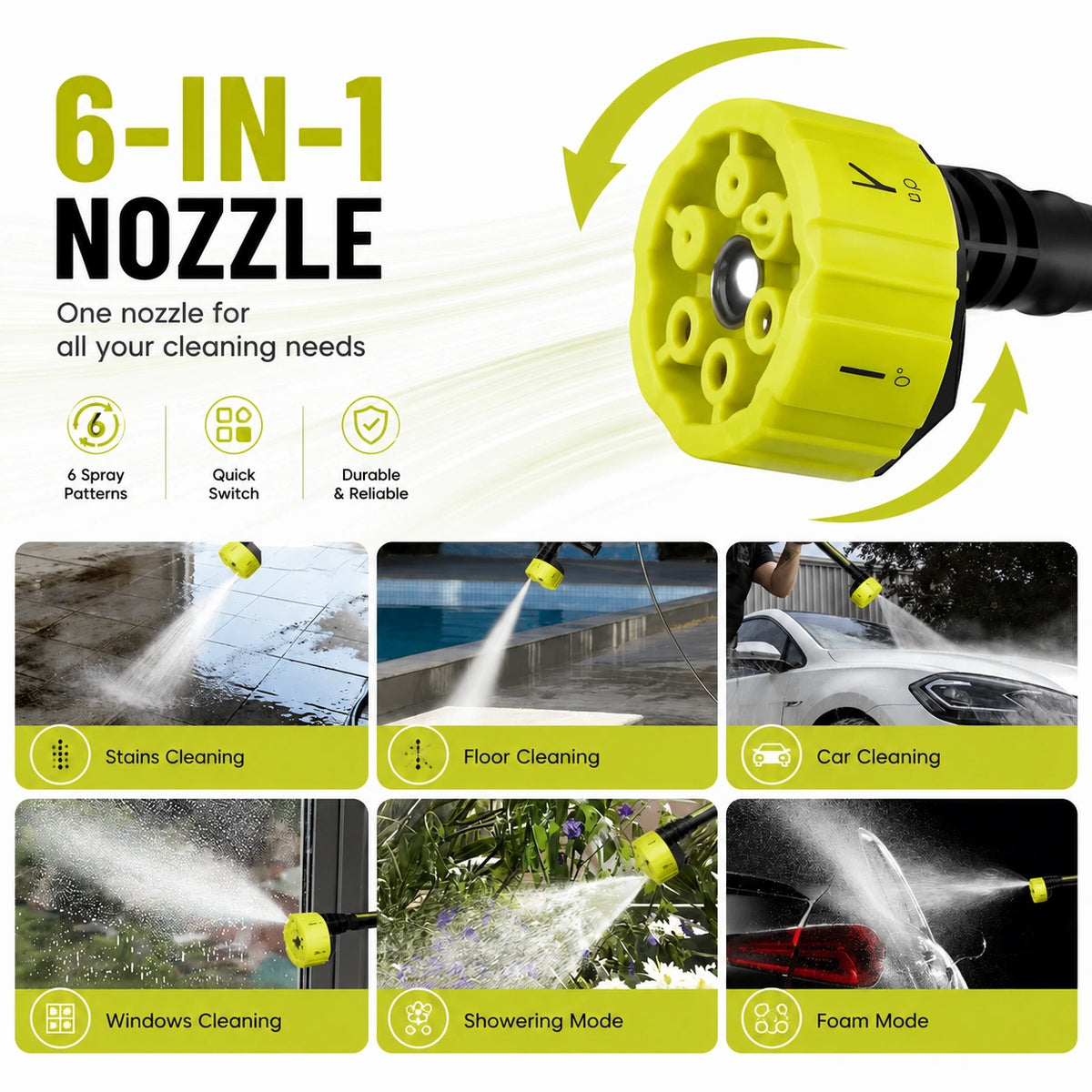
Here the force is a shape you set at the nozzle, one-handed, mid-job: a wide, paint-safe fan for the car and the windows, through to a focused jet for the grime line on the concrete. Six patterns on one head.
Strong enough to clean. Gentle enough to trust on the things you actually care about.


Cordless Portable Pressure Washer
Cordless Portable Pressure Washer
Cordless Portable Pressure Washer
Get it between - and -.


Light Enough To Use With One Hand
A gas washer is a 40-to-60-pound appliance you wheel around like luggage. This is 2.9 pounds with the battery on.
Hold it over your head for the gutter line. Crouch under the wheel arch. Hand it to anyone in the family without a safety briefing.
The tool you'll actually reach for is the one that doesn't feel like a commitment.

One Tool For Everything You Own
Car, truck, bike, boat hull, RV, muddy dog, solar panels, patio furniture, trash cans, window screens, camp gear before it goes back in the garage.
The kit comes ready: 6-in-1 nozzle, foam pot for soap jobs, hose and filter for bucket draws, charger and case.
It's not a driveway machine. It's a go-where-the-mess-is machine.

A Battery That Outlasts The Job
The 4000mAh battery runs 20–30 minutes of continuous spray — and almost no job is continuous spray. A full car wash, a patio, a fence line: done with charge to spare.
It recharges from any indoor socket in a few hours. No fuel can, no oil, no service appointment to bring it back to life in spring.
Charge it Friday night, and Saturday belongs to you.

Try It On Your Worst Job For 90 Days
A mobile detailer charges $50–$200 per visit. A gas washer is $200–$400 before its first $80 repair. This costs $54.95 — and it's the only one of the three that answers to you.
So test it on the job you've been avoiding: the green deck, the winter-filthy car, the driveway stain. You get 90 days.
If it doesn't earn its spot in your garage: free return shipping, prepaid label, no restocking fee, every penny back. Thirteen Saturdays to find out.

What Customers Are Saying
The gas washer is gone from my garage
Mine sat dead for two summers — wouldn't start, then the repair quote was half the price of a new one. This little thing cleaned my whole deck on one charge, straight out of a bucket. I sold the gas unit that weekend.
I wash my car in an apartment lot now
No spigot, no outlet, building says no hoses. I fill a bucket in my kitchen, ride the elevator down, and my car is clean in 25 minutes. I genuinely didn't believe it until my neighbor asked what detailer I use.
The 4-hour driveway took 40 minutes
I used to scrub the patio on my knees every spring and swear about it every spring. This did the whole thing in under an hour, and the foam pot makes the car wash stupidly easy. My back has opinions about how long I waited.
Your Questions, Answered
Fair question — it's the category's #1 fear. Here's the honest answer: this adjusts from 300 up to about 1,000 PSI. That's several times a garden hose, and less than a gas monster — on purpose. The jobs it's built for (cars, decks, patios, fences, bikes, grills) want controllable pressure, not paint-stripping force. And unlike the gas machine, it delivers that pressure anywhere you can stand — which is the number that actually decides whether the job gets done.
Yes — that's the core of the design. The included suction hose and filter lift water from any still source up to about 4 meters: bucket, barrel, tank, pool. No tap required.
20–30 minutes of continuous trigger time from the 4000mAh battery — enough for a full car wash or a patio session, since real jobs are spray-move-spray. It recharges in 3–4 hours from a normal indoor socket.
Yes — use the wide fan pattern and the foam pot. The whole point of the adjustable nozzle is that YOU set the force. Keep the focused jet for concrete and grime lines, not paint.
The washer, 21V 4.0Ah battery, charger, 6-in-1 nozzle, foam pot for soap, suction hose with water filter, hose connect adapter, and the storage case.
Stick to cool or lukewarm water — it protects the pump seals. For greasy jobs, let the foam pot and detergent do the extra work.
This is the one pressure washer winter can't kill: no engine to winterize and no permanently-plumbed pump. Drain it, charge the battery now and then, and store it indoors in its case.
A fraction of a gas engine — normal-conversation territory. You can wash the car at 7am without meeting your neighbors.
Free on every order. Processing takes 1–2 business days and delivery typically 5–12, with tracking as soon as it ships.
You get 90 days from delivery to test it on your real cleaning list. If it doesn't earn its keep: free returns both ways, prepaid label, no restocking fee, full refund. Email support@selorna.com and a real person handles it.